How people development drives transformation
At Timmermann, we support companies that want to not only manage change, but live it. One of these partnerships connects us with ABB – a global industrial company that has successfully made people development a strategic lever.
Together with Francesca Gervasoni's people team, a system was set up in one business line that links culture, learning, and performance. Instead of designing programs that work on paper, the aim was to make development concrete, measurable, and part of everyday life.
The following insights show how ABB implemented this, what specific initiatives were developed, and why this approach goes beyond traditional personnel development.
How ABB links learning, culture, and performance
Many companies talk about development, training, and talent promotion. On paper, this sounds convincing. In everyday life, however, little of this is often noticeable. Processes are running, training courses are taking place, but actual progress rarely keeps pace.
ABB wanted to change that. In a business line with over 6,000 employees, a system was created that combines learning, culture, and performance. The goal was to treat development not as an HR project, but as part of everyday work and everyone.
The key was to create shared values and formats that link learning and attitude.
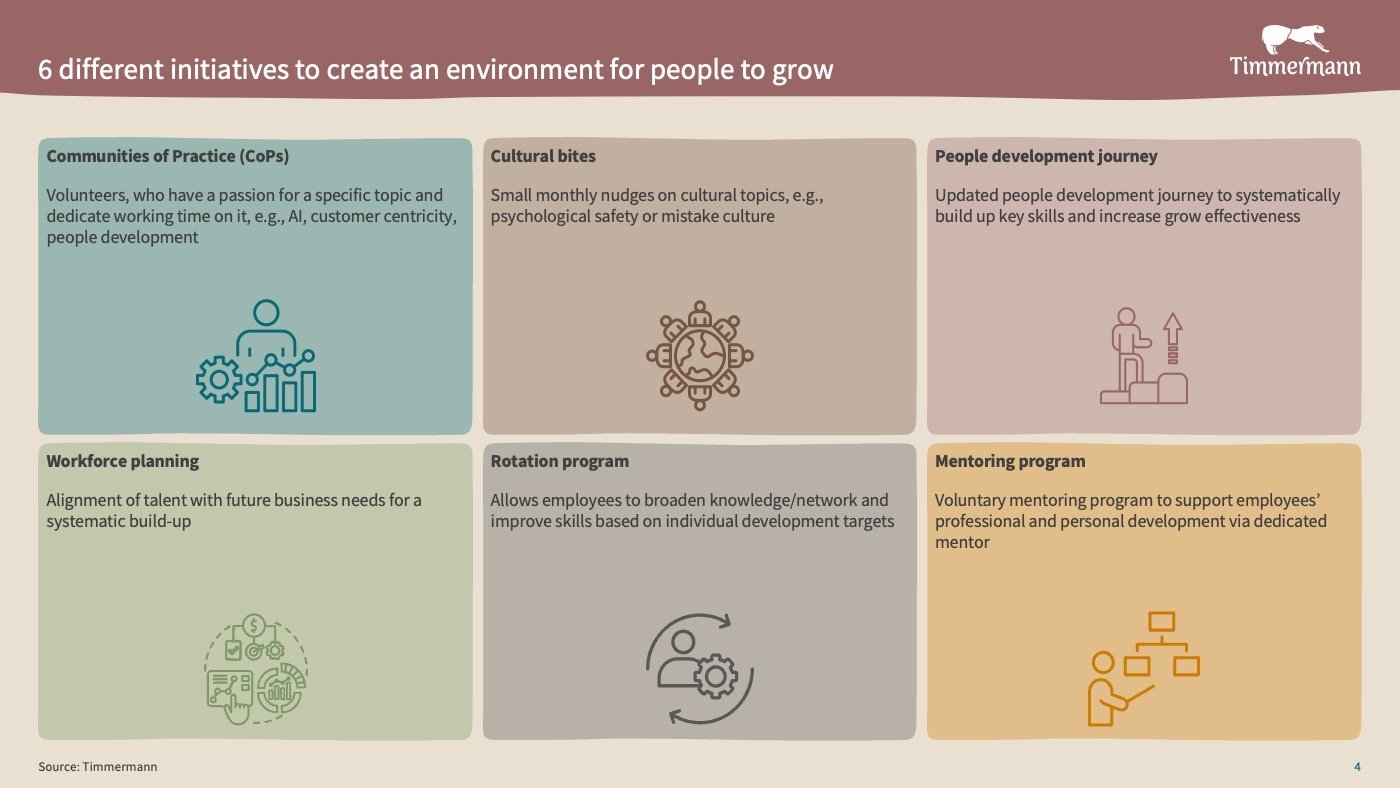
This resulted in six initiatives that reinforce each other:
- Communities of Practice
- Cultural Bites
- People Development Journey
- Workforce Planning
- Rotation Program
- Mentoring Program (currently to be implemented)
Each initiative follows the same principle: bringing people together, sharing responsibility, and making development visible.
1. Communities of Practice - Engagement with structure
It all started with the Communities of Practice. Volunteers come together to discuss topics that are central to the business line. They invest time on-top of their actual job and take responsibility for a common cause.
Three communities are currently active:
- Customer Centricity
- People Development
- Artificial Intelligence
Each consists of volunteers who care about the topic. A small core team (around 5 people) is responsible for CoP management. It meets weekly to work on initiatives and deliver results. The other members provide support, give input, and reflect on progress.
Initially, the groups were significantly larger. However, with too many participants, it became difficult to make decisions and maintain energy. Today, the clear division into a core and an extended circle ensures commitment and momentum.
The communities function like a laboratory. Here, they test how ideas can be put into practice. The principle of voluntariness encourages commitment. Those who participate do so out of interest in the topic. This inner motivation maintains the momentum, even without formal pressure.
In terms of content, the communities cover different areas of focus:
Customer centricity ensures that decisions are based on the benefits for the customer.
People development ensures that development processes reach everyday life.
Artificial Intelligence deals with new technologies and their possible applications.
Together, they form a network that keeps topics moving that would otherwise easily get bogged down in the system. Over time, additional CoPs will certainly be established.
2. Cultural Bites - Bringing culture to life
To initiate cultural change and anchor it in the organization, formats were needed that bring to life what collaboration means.
Cultural Bites are short, focused learning units lasting around 90 minutes. They combine technical input with personal reflection and practical exercises. Each session is jointly facilitated by a manager and a Timmermann consultant. After a short introduction to the topic, examples from everyday working life and a personal story of the facilitator are presented, followed by small group exercises in which participants practice how the topic can be applied in their own team.
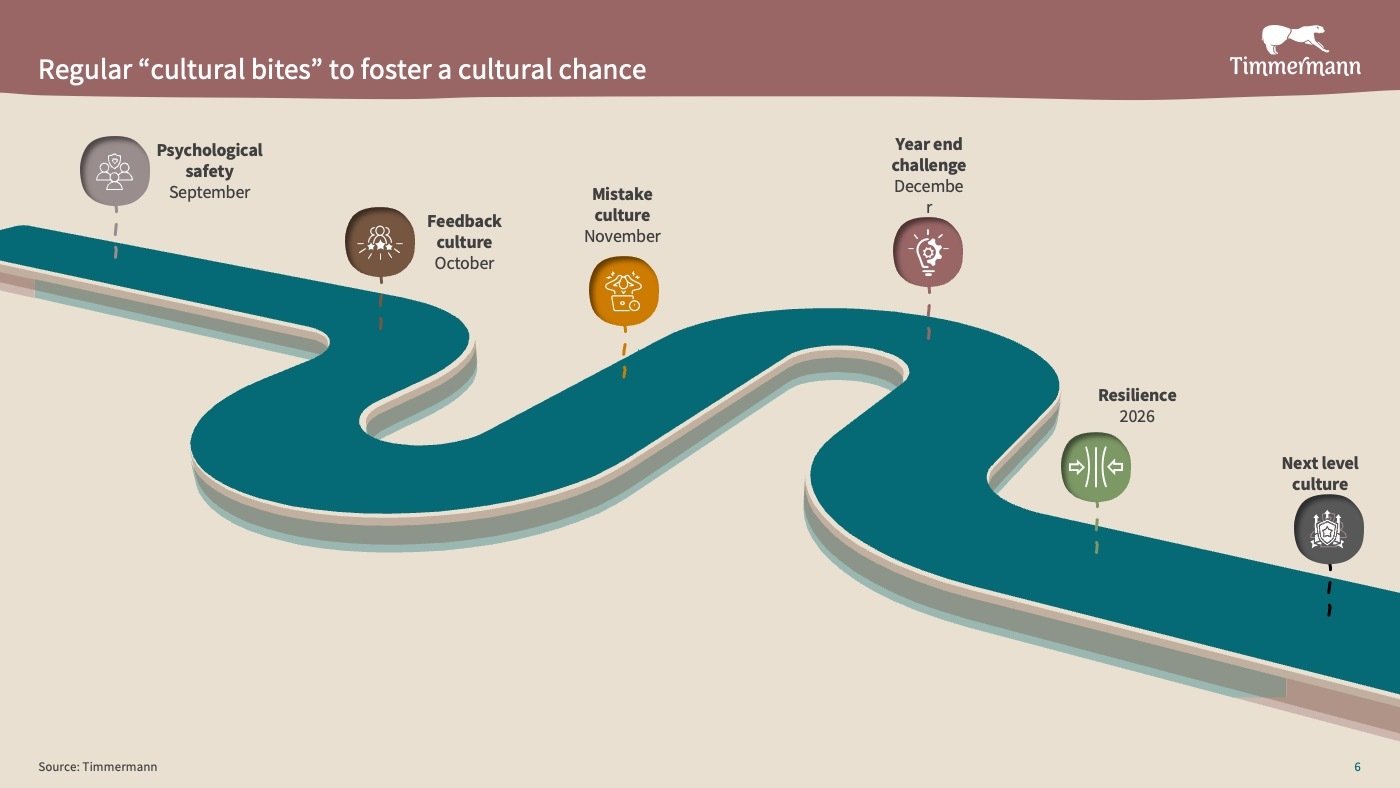
Four topics have been covered as Culture Bites so far:
- Psychological Safety
- Feedback culture
- Mistake culture
- Resilience
The order has been deliberately chosen. Safety creates trust. Trust enables feedback. Feedback opens up space for learning and a culture of mistake and learning. Resilience stabilizes this process.
There are two sessions per topic to cover different time zones. Between 60 and 100 employees take part. Participants experience that culture is not an abstract concept, but is created through behavior. They learn what psychological safety means, how feedback works, and why dealing openly with mistakes promotes trust.
Change starts small. Teams talk more about safety and communication. Managers use feedback in a more targeted way. Employees feel that learning is becoming part of everyday life. This creates a culture that is defined not by rules, but by shared experience.
3. People Development Journey - Learning about skills
The People Development Journey makes development tangible. It shifts the focus from the process to specific skills.
ABB has analyzed key roles and described four to six core skills for each. Each is backed up by observation criteria, making it clear what behavior characterizes a particular skill level. On this basis, managers and employees hold regular discussions about the current status and the desired level.
The assessment is made on a scale of one to five. This creates a common understanding of skills. Subjective impressions are replaced by observable behavior. This makes development discussions more concrete and comprehensible.
This exchange results in an individual plan with clear goals and measures. The time frame varies depending on the topic and role: three months, six months, or more. It is crucial that the steps remain realistic and enable visible progress.
A pilot program is running with around thirty employees from different departments to gather insights and experience at an early stage so that the process can be adjusted if necessary. It is supported by an AI-based solution that suggests suitable learning opportunities and resources. The system combines internal programs with external literature and recommended sources of experience.
Learning thus becomes part of the workflow. Employees see which skills are crucial for their role and what options are available to them. Managers actively accompany this process and develop new skills in dealing with feedback and coaching.
The approach shows that a clear structure promotes responsibility. When people know where they stand and where they want to go, they begin to take control of their own development. In this way, the People Development Journey combines individual learning with organizational agility.
4. Workforce Planning - Planning for the Future
Workforce planning sounds technical and “boring”, but it has a big impact. It provides an overview of the skills and resources an organization needs to achieve its goals.
Some units at ABB are facing strong growth. Some will double or triple their output in the coming years. Such changes cannot be implemented spontaneously. They require planning, not only in terms of numbers, but also in terms of skills.
The team has therefore begun to translate long-term business goals into capacities. Personnel requirements were derived from planned sales figures. The question was: What people with what skills are needed to reach the next stages of development?
The respective managers were then involved. Together, they examined which skills were available, which were missing, and how they could be developed. In some cases, the solution lies in internal knowledge transfer. Instead of creating new positions, existing teams are strengthened or colleagues from other regions are brought in.
Workforce planning combines business goals with personnel development. It shows how many employees are needed, what skills they need, and what measures are necessary to develop them. In addition to skills, the process also takes physical resources into account: workspaces, technical equipment, infrastructure.
The method creates transparency. Managers understand early on what demands their teams will face and can respond in a targeted manner. Growth is thus planned and enabled pro-actively, not reactive.
5. Rotation Program - Learning through a change of perspective
The rotation program opens up new ways of learning. It enables employees to work in another unit for a limited period of time and gain practical experience there.
The aim is to build knowledge and develop skills where it is needed. Anyone who wants to improve a skill should learn it directly from colleagues who are already strong in that area. Instead of attending seminars, participants experience learning in the everyday life of another department.
An example: An employee wants to develop her planning skills. In another country, there is a team that is particularly advanced in this area. She joins this team for a few weeks, accompanies processes, observes procedures, and works alongside them. She then returns, brings what she has learned to her own environment, and passes on her experiences.
This form of learning has several effects. Knowledge is gained from experience. People build relationships. Cross-border collaboration becomes a matter of course.
The duration of the rotations remains flexible. For some topics, seval days are sufficient, while others require several weeks. The program opens for applications twice a year. After selection, participants have six months to plan and carry out their assignment.
The Rotation Program makes development tangible. It strengthens personal responsibility and promotes a learning attitude. Employees experience that learning is not controlled from outside, but happens in practice.
At the same time, networks are created that extend beyond departments and countries. People who have worked together stay in touch. They understand processes better, share knowledge more quickly, and thus create a culture based on trust and cooperation.
6. Mentoring Program - Quality through attitude
The Mentoring Program adds a personal dimension to the structural initiatives. It is based on voluntary participation and mutual support. It is currently in the definition phase and will be implemented later.
Employees will be able to use a dedicated system to indicate whether they would like to become a mentor or are looking for support as mentee. The openness of this format creates opportunities, but also requires guidance.
That is why there will be a short introduction for everyone who registers as a mentor. In a one-hour session, accompanied by Timmermann, the basics of effective mentoring are taught: active listening, open questions, respectful distance, and confidentiality. The goal is to encourage conversation and initiate development rather than prescribe solutions.
Mentoring at ABB is not seen as a hierarchy, but as an exchange. Those who share knowledge learn themselves. Those who mentor broaden their own perspectives.
The program brings together people who can learn from each other. Managers, specialists, and young talents meet on equal terms. Connections are formed across countries and departments that have an impact beyond the individual learning process.
This creates a culture in which learning becomes part of the relationship. Development does not take place in the seminar room, but in conversations that build trust.
Lessons learned from practice
After a year of intensive work, the impact of the people development system at ABB is now becoming apparent. Not all initiatives are yet fully rolled out, but already now a first impact is becoming visible. The six initiatives have brought movement into the organization. Clarity provides orientation. Employees know what the programs stand for and what role they play in them. Voluntary participation creates energy because involvement is based on genuine interest. Communication connects the initiatives and ensures that learning does not fizzle out but keeps moving forward. This is how a system grows that is self-sustaining and continues to develop.
In the course of the process, it became clear that change takes time. New formats can only be effective once people understand them, try them out, and apply them in their own working environment. That is why ABB is introducing each initiative step by step. This pace creates space for reflection, feedback, and acceptance. Each measure is accompanied, explained, and adapted. This builds trust and makes progress visible.
To understand what works, ABB regularly measures the progress of all programs. The goal is to learn from the results and make development transparent. For Cultural Bites, feedback and participant numbers are important. The Communities of Practice record which projects have been implemented. The People Development Journey documents progress through competency discussions and development plans. Rotation and mentoring measure impact and satisfaction.
This feedback shows where energy is being directed, where momentum is building, and where adjustments are needed. Some formats have a rapid impact, while others develop over time. Every experience feeds into the next round, making learning a permanent part of the organization.
Strong communication is needed for this cycle to work. It holds all parts of the system together and makes development visible. ABB uses various channels for this purpose. Experiences are shared via internal networks, managers discuss progress in leadership calls, and the HR community regularly brings topics to the teams.
This constant exchange keeps the topics alive. Employees understand what is happening and can identify with the goals. Development becomes a common point of reference that connects teams and makes conversations about learning a matter of course.
At this point, leadership decides how deeply development is actually anchored in everyday life. HR can create structures, but everything is lived out in the teams. Managers accompany learning processes, stimulate discussions, and build trust. Control takes a back seat, and personal responsibility comes to the fore.
Regular reflection replaces formal evaluation. Progress is noticed, shared, and recognized. Step by step, a culture emerges in which learning is part of daily work and development takes place continuously.
Sustainability in change
Sustainable change only happens when structures remain in place even after projects are completed. This was precisely the goal ABB had in mind when it developed its people strategy.
Today, the communities work independently and keep key topics alive. Cultural Bites are firmly anchored in the annual plan and regularly provide new impetus. The People Development Journey grows with each new role and thus remains relevant. Workforce planning combines development with strategic planning and ensures that growth remains predictable. The rotation and mentoring program aims to develop personal and professional skills.
This creates continuity. Change becomes a natural part of everyday work. It does not overwhelm, but promotes orientation and stability. The organization learns to develop itself further. This is precisely what makes it adaptable in the long term.
This development is not only reflected in key figures. It is also reflected in people's behavior. Teams talk more openly about mistakes and decisions. Feedback has become a matter of course. Employees contribute ideas, ask questions, and take responsibility. Leadership is more cooperative, and collaboration is more direct and trusting.
Culture grows when people share experiences. The six initiatives create spaces where learning becomes visible. This changes everyday life step by step. With it, the culture throughout the organization also changes.
What other organizations can learn from this
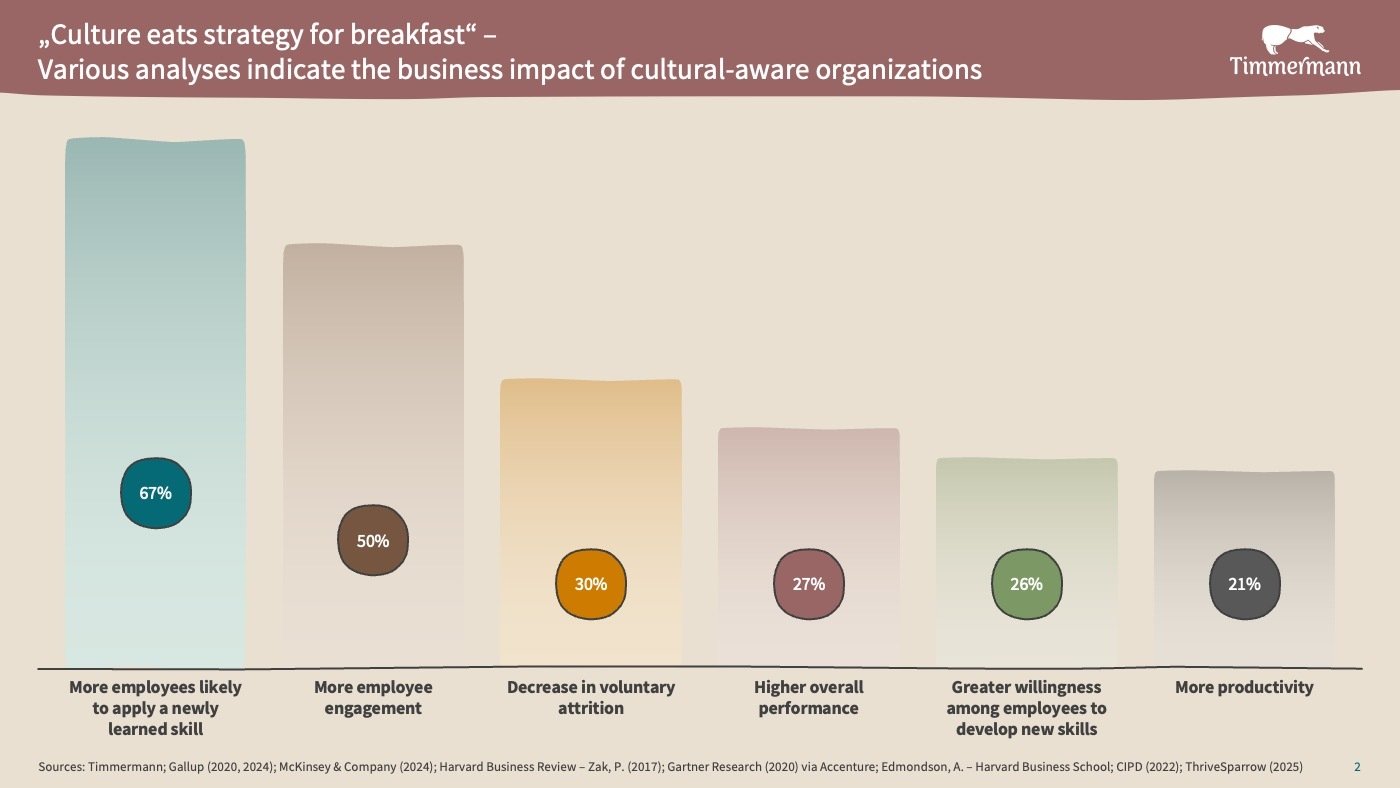
Many companies wonder how learning strengthens culture and boosts performance. The experience at ABB shows a clear pattern: impact occurs when three things interact and support each other.
First, learning needs to be integrated into the workflow. People develop through collaboration, discussions, and decisions. Short formats such as Cultural Bites provide impetus that is directly transferred into everyday life.
Second, structure is needed for voluntary participation. Clear roles, fixed time slots, and visible results maintain energy.
Third, communication that supports the process is needed. Content is explained, repeated, and placed in the right places. Managers talk about it regularly, HR curates it, and teams reflect on their experiences. This keeps development in the foreground.
If you want to implement this, it's best to start in four steps:
- Clarify the starting point: Identify and evaluate roles, skills, ongoing initiatives, and existing learning channels.
- Set the focus: choose one or two initiatives and tailor them for impact. Then go to the next initiatives.
- Define measurement points: participation, feedback, observable behavior, progress in skills.
- Establish a communication rhythm: what becomes visible when and where, and who is responsible.
Timmermann supports you with a comprehensive approach. We combine people strategy, cultural work, and implementation expertise. We work with you to develop formats, check measurability, establish communication flows, and support leadership in their daily work. The goal is to create a system that is self-sustaining.