The question “How will we work tomorrow?” sounds harmless.
It brings to mind working from home, modern offices, and the next discussion about work hours. But underlying it is a more uncomfortable question:
How much change can an organization withstand when work is reimagined?
New Work is often discussed in terms of visible elements: remote work, open-plan offices, coworking spaces, agile methodologies, greater autonomy, and spaces to recharge.
That’s tangible. But it falls short when the core is missing.
Because New Work doesn’t just change where we work. It changes expectations regarding leadership, collaboration, and responsibility. It asks how work must be structured so that people can make their contributions and organizations remain agile.
That’s exactly why New Work isn’t just about office design. It’s transformation.
What New Work means
The term New Work goes back to the social philosopher Frithjof Bergmann. Today, it describes a fundamental and sustainable change in the world of work (cf. Hackl et al. 2017: 3).
The idea emerged in the early 1980s as a socio philosophical concept. In current organizational practice, New Work is used in a broader sense. It includes work life balance, flexibility, agility and the creation of meaning in work. Digital transformation has enabled and accelerated this development (cf. Hofmann et al. 2019: 4).
New Work means the deliberate redesign of work toward flexibility and participation, with a stronger connection to meaning.
Hofmann et al. identify four directions of New Work. These include flexibility in place and time, agile and project based forms of organization, value based work and meaning through work (cf. Hofmann et al. 2019: 4).
Technology and digital transformation also trigger developments in day to day business (cf. Bünnagel and Adsiz 2024: 13).
For organizations, the central question is practical: Which form of work helps us stay capable of acting while we change?
What “New Work” Means
The term “New Work” was coined by the social philosopher Frithjof Bergmann. Today, it generally refers to a fundamental and sustainable transformation of the world of work (see Hackl et al. 2017: 3).
Its origins date back to the early 1980s. At that time, “New Work” was a social-philosophical idea. In today’s organizational practice, the term encompasses, among other things, work-life balance, flexibility, agility, and finding meaning through work. The digital transformation acts as both an enabler and an accelerator in this context (see Hofmann et al. 2019: 4).
In short: New Work describes the redesign of work to incorporate greater flexibility and a stronger sense of purpose.
Hofmann et al. describe four key areas of focus. These include flexibility in terms of location and time, agile and project-based organizational structures, a values-based approach, and the creation of meaning through work (see Hofmann et al. 2019: 4).
Technological advancements and digital transformation are also driving developments in day-to-day business (see Bünnagel and Adsiz 2024: 13).
This makes it clear: New Work is not a single concept that can be introduced like a new tool. It is a shift in the organization’s operating system.
The Fallacy
New Work is often implemented where it can be photographed.
A new office layout. A work-from-home policy. A few agile rituals. Maybe even a program for managers.
That can make sense. But it falls short if the organization leaves its underlying work logic untouched.
An open-plan office doesn’t automatically foster collaboration. Remote work doesn’t automatically build trust. A flatter hierarchy doesn’t automatically encourage participation if decisions continue to be made according to the old patterns.
The blind spot lies in treating New Work as a set of measures.
The more important question is: What kind of work requires what conditions?
Some work requires focus. Some work requires interaction. Some work requires quick decisions. When organizations take these differences seriously, New Work becomes more concrete. Then it’s no longer about modern buzzwords, but about better work design.
Flexibility Requires Reliability
An important aspect of New Work is the ability to work from different locations. Working from home and remote work can support this. To make this possible, work processes must be executable regardless of location.
That sounds like an organizational issue. In practice, it’s a leadership issue.
When information remains tied to individual people, flexibility becomes fragile. When decisions are made through side agreements, people outside the office are less effectively integrated. When physical presence serves as a substitute for trust, remote work becomes a test of mistrust.
Flexibility therefore requires clear work processes. Employees need to know where information is located, how coordination works, and when direct collaboration makes sense.
The real point is this: freedom works better within a framework.
Without a framework, people end up wasting time searching for information. With too much control, flexibility loses its value. New Work demands precisely this balance.
Spaces Send Messages
Office spaces are never neutral.
They reveal the kind of work an organization aims to facilitate. Open-plan offices and coworking spaces can foster communication between teams when collaboration is needed for the job.
But interior design shouldn’t stop at openness.
Work also involves concentration. It involves breaks. It involves moments when energy needs to be replenished. Spaces for exercise or relaxation can help employees recharge during breaks so they can tackle the rest of the workday.
At Timmermann, they have the “Raum Raum” for this purpose. It features a bed for a power nap and exercise equipment for short workouts.
This example is small, but it illustrates a larger point: Organizations don’t just design processes. They design the conditions under which people can remain productive.
So “New Work” also asks: What kind of environment supports the work that needs to be done here?
Leadership Must Redefine Control
Flat hierarchies sound appealing. But putting them into practice quickly becomes challenging.
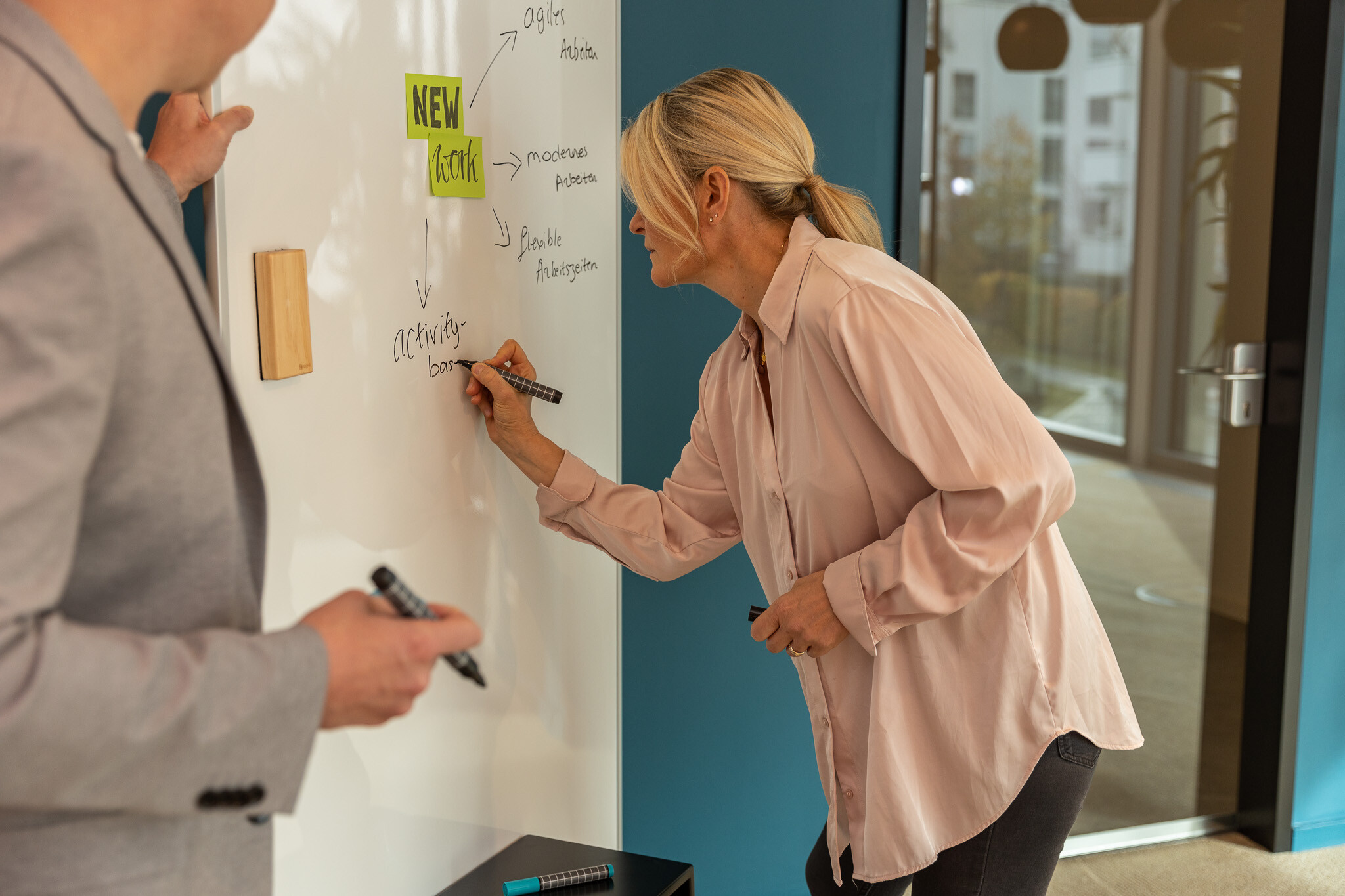
That’s because less hierarchy requires more clarity. Those who relinquish control must take participation seriously. Those who want to promote participation must clearly define decision-making boundaries.
Otherwise, confusion arises.
Employees are expected to act independently but don’t know where their decision-making leeway begins. Managers want to let go but end up intervening again when faced with uncertainty. The organization talks about participation but, in practice, sticks closely to a culture of control.
Timmermann puts this principle into practice through a learning community and a positive culture of learning from mistakes. Employees regularly give each other feedback and actively learn from their mistakes.
This is central to New Work because self-determination without a culture of learning can quickly become overwhelming. Those who want more responsibility need feedback. Those who want to learn from mistakes need a space where learning is possible.
Leadership Requires Support
Another measure is coaching for leaders. It helps leaders help themselves and can be applied flexibly.
This is relevant because New Work does not make leadership any easier.
Leaders are expected to provide guidance while also enabling participation. They are expected to reduce control while still maintaining accountability. They are expected to strengthen teams while simultaneously ensuring strategic direction.
This tension can hardly be resolved by a new mission statement.
Coaching can help leaders reflect on their own approach to control, trust, and participation. This makes New Work visible in leadership behavior and ensures it remains more than just a headline in a cultural policy document.
Learning Needs Structures
Communities of practice can be used as an open forum for exchange, for example, on hybrid work topics. They support learning across functional boundaries.
Their value lies in ensuring that experiences from day-to-day work do not remain isolated.
When teams try out new ways of working, questions arise. What works well in a hybrid setting? Where is connection lost? Which routines help establish connections without requiring extra effort?
Such questions need spaces where they can be addressed.
A community of practice can create this space. It makes learning a collaborative effort and brings together experiences from different areas.
This makes New Work more accessible. It doesn’t remain merely a concept but is grounded in experience.
Individuality Needs Direction
New Work goes hand in hand with the promotion of individuality. This includes employee participation in strategy development and the setting of their own learning and performance goals. Self-determination also plays a role, for example, when part of the workday can be used for creative or personal projects (see Hackl et al. 2017: 72).
This is more than just a cultural bonus.
Freedom and participation in organizational processes can foster commitment. Hackl et al. describe commitment as a key factor influencing the quality of goal achievement. It can also strengthen loyalty to the organization and increase enthusiasm (see Hackl et al. 2017: 74).
This point is important for transformation. People are more likely to support change when they are not merely affected by it, but can understand and shape their own contribution.
Individuality requires a shared direction. Without direction, energy dissipates. With direction, self-determination can become a source of strength.
Our Impact
Our contribution lies in moving New Work beyond the logic of mere measures.
Organizations don’t need a fancier label for flexible work. They need clarity on which work models fit their transformation and what conditions must be created to support them.
We help organizations combine New Work with leadership, structure, and the ability to learn. This involves addressing specific questions: Where does work need more flexibility? Where does it need more clarity? Where does control hinder accountability? Where is there a lack of a framework for learning from experience?
This is how New Work becomes effective in everyday life—not as a trend, but as consciously designed work.
What Remains
New Work is relevant because work is changing due to digitalization, new expectations, and different forms of collaboration.
Organizations can respond by offering more: more remote work, new spaces, agile formats. But the most powerful lever lies deeper.
New Work has an impact when organizations design work more consciously. When flexibility is combined with reliability. When leadership enables participation. When spaces, routines, and learning formats align with the work.
Then the question “How will we work tomorrow?” becomes a leadership question:
What conditions are we creating today to ensure that work remains sustainable tomorrow?
Sources
- Bünnagel, W.; Adsiz, S. (2024): Modern Teaming. Praxisleitfaden für eine digitalisierte Arbeitswelt. 1. Aufl., Schäffer Poeschel Verlag Stuttgart
- Hackl, B.; Wagner, M.; Attmer, L.; Baumann, D. (2017): New Work: Auf dem Weg zur neuen Arbeitswelt. Springer Gabler
- Hofmann, J.; Piele A.; Piele, C. (2019): New Work: Best practices und Zukunftsmodelle. Fraunhofer Institut für Arbeitswirtschaft